


My husband and I marked our 33rd anniversary on May 29. I find this fact nothing short of impossible.
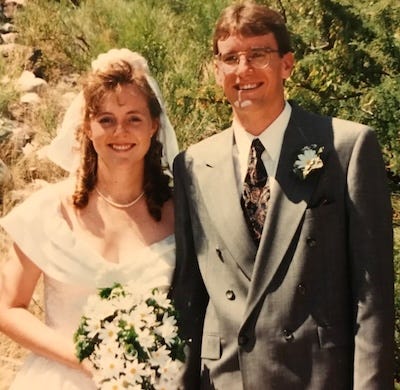
At the time of our wedding, at the fragile age of 23, I loved him. And I liked him most of the time. But, just as much, I imagined a particular kind of life I was going to have with him. He was about to become a Ph.D. student in neurobiology, headed for a career as a university researcher. I knew the researchers he worked for. I had visited their homes, and they lived comfortable, middle class lives. I wanted what they had, and it came packaged with a man who inexplicably wanted me.
So, we pulled off a ceremony and reception with the last few dollars of our college Pell grants and drove to St. Louis where Washington University had offered him a spot in their program. Our first year of marriage was terrible. Neither of us was fit to try to make a life with anyone at that point. A few easier years followed. Then he dropped out of graduate school, and I could have been disappointed at the loss of my imagined life except that I was too busy starting my own career in the church and having babies. Parenthood stretched and stressed me in painful ways, and we fought. I overfunctioned. He withdrew. I grew tired of bearing the burdens. I screamed. He withdrew more. He’s sorry now, looking back, about how little he contributed to raising the kids and making a home. I’m embarrassed by how angry I was for so long and how I took it out on him and the kids. We should not be married anymore, but, by the grace of God and my husband’s tenacity, we are still together.
We hit a sweet spot about nine years ago. I can’t explain all that changed in and around us, but my anger ebbed. He stepped up around the house. Our daughter came into the family room one night from the kitchen and asked what was wrong with Dad. I looked up, concerned. “He’s loading the dishwasher,” she explained. I smiled back. Maybe we’d both just finally grown up.
More than anything, we began to enjoy each other. We started making each other happy in ways we hadn’t before. I have no idea why or how, but I’m not complaining. Maybe it’s all pālā.
I stumbled upon this funny Hebrew word pālā this month while preaching on Genesis 18. It’s the word God uses when he questions Sarah, “Is anything too pālā for the Lord?” (Genesis 18:14). It can mean hard, or it can mean wonderful. How fabulously wise of the Hebrew language to recognize that something hard can be wonderful and something wonderful can be hard? Like marriage?
Still curious, I pulled out the Septuagint to see how it translated pālā into the Greek and found adynateō, which happens to be the word the angel uses to announce to Mary that she’s about to give birth to the Messiah. “For nothing will be impossible with God” (Luke 1:37).
Wonderful. Hard. Impossible. All somehow the same idea. Hard things can be wonderful, and wonderful things can be hard. It seems impossible, yes, but nothing is too pālā for the Lord. Even 33 years of marriage.
I know couples in town and nearby–I’ve counseled some of them–who have ended their marriages and moved on. Some are still weighing their options now. So be it. I don’t stand in judgment. The three A’s (adultery, abuse, abandonment) certainly give cause to consider it.
But to those couples still shy of these thresholds, but for whom marriage is stale or tedious or angry or wearying, I give this humble, unsolicited advice: “Butt in chair.”
“Butt in chair” is the advice the writer Anne Lamott gives when fledgling writers ask her for guidance. “Butt in chair,” she responds. She means that they have to keep writing in order to be writers. Butt in chair, fingers on keyboard or pen in hand, do it. The writing will be awful at times, and it will need to be revised again and often again, but, without that butt in the chair, they can’t accomplish the work that nourishes their souls.
“Butt in chair” works about the same for husbands and wives. For us, “butt in chairs” looks like hands doing the work and hearts hanging on. It might look like counseling or canoodling or cutting the other some slack when mistakes are made. However it looks, we have to stay married in order to be each others’ spouses. Butt in chair.
I’ve heard the desperation, the husbands and wives pleading, “But what if I don’t want to be a spouse any more?” I’ve been there. Nobody wants to be an unhappy spouse, but to be a happy spouse–to be valued and cared for, loved and listened to–is a gift given over time. We can neither give it nor receive it if we’ve left the room. We have to stay together if we want to grow up into the people we want to be for ourselves and each other.
We’re not bored with our spouses because something is wrong with our spouses. We’re bored because sometimes marriage is boring. If it’s a struggle to keep communicating with our spouse, it’s not because one of us is necessarily at fault. It’s because communicating is just tough work.
“The reason marriage is ‘till death do us part’ is not because the initial flame of passion is so strong,” writes Tish Harrison Warren, “but because love requires so much time–a lifetime–to even sort of learn what it is to practice it” (Tish Harrison Warren in What Grows in Weary Lands).
In the depths of those angry years in our marriage, I could not even have pictured the life we have now. It would have seemed impossible. It was hard then and still hard now sometimes. And it is absolutely wonderful.
It’s all pālā.